FOR PROFITABLE OWNERS OF SERVICE-BASED AND DIGITAL BUSINESSES THINKING ABOUT A FUTURE EXIT
Profitable Businesses Go to Market Every Day and Still Fail to Sell.
A profitable business can still fail the buyer’s test.

Because the market does not pay for your effort, your history, or the value you know is buried inside the business. It pays for what survives scrutiny, transfers without you, and can be defended when a buyer starts looking for risk.
Before you talk to a broker, request a valuation, or let a buyer start asking questions, find out what could cut the price, rewrite the terms, or kill the deal.
If you are thinking about selling, stop asking who you should call first.
Ask the harder question:
If a serious buyer looked beneath the revenue tomorrow, would they see a business they want to own, or a pile of risk they have to price around?
You may have spent 10, 20, or even 30 years building the business, making it profitable, and carrying it through problems nobody else could solve.
The last thing you want is to reach the finish line and discover the market does not see what you see.
Let me show you what I mean.
Does any of this sound like you?
Most owners do not ignore the danger.
They explain it away.
Usually with something that sounds perfectly reasonable:
“I am not selling tomorrow. I have time.”
Maybe you do. But the changes that matter need a track record. You cannot manufacture years of cleaner operations, stronger leadership, or safer revenue the week before you list.
“The business makes good money. Buyers will see that.”
They will see the profit. Then they will ask how much disappears when your roles are replaced, whether the clients stay, and how much of the result still depends on you.
“I know there are things to fix. I just do not know where the hell to start.”
The books. The team. The SOPs. The customer mix. The margins. The handoff. Everything looks important, so you fix what is easiest to see and hope it was the right thing.
“I know it needs work. I am already carrying too much.”
You are already the person every important problem rolls uphill to. Another major project feels impossible, even though the business depending on you is exactly what keeps the pressure from ending.
Same betDifferent reasons. Same bet: that the market will agree with the story you have been telling yourself.
What you call a strength can become a buyer’s reason to discount the business.
You know the history behind the numbers. You know why each exception exists, which client needs special handling, which employee can be trusted, and which problems you can solve before anyone else notices.
A buyer does not inherit that history. They inherit whatever the business can repeat after control changes.
The owner hears context. The buyer prices exposure.
| What the owner says | What the buyer may hear |
|---|---|
| “Our clients are loyal. They have been with us for years.” | “Are they loyal to the company, or to the owner who holds the relationship?” |
| “Our margins are strong because I cover several key roles.” | “What happens to profit when those roles have to be replaced at market cost?” |
| “Revenue has grown every year.” | “How much is recurring or repeatable? How concentrated is it? What is likely to survive the handoff?” |
| “We keep things flexible. Everyone knows what needs to be done.” | “How much of the operating system lives in people’s heads instead of the business?” |
What the owner says
“Our clients are loyal. They have been with us for years.”
What the buyer may hear
“Are they loyal to the company, or to the owner who holds the relationship?”
What the owner says
“Our margins are strong because I cover several key roles.”
What the buyer may hear
“What happens to profit when those roles have to be replaced at market cost?”
What the owner says
“Revenue has grown every year.”
What the buyer may hear
“How much is recurring or repeatable? How concentrated is it? What is likely to survive the handoff?”
What the owner says
“We keep things flexible. Everyone knows what needs to be done.”
What the buyer may hear
“How much of the operating system lives in people’s heads instead of the business?”
And once a buyer sees exposure, they do not leave it as a question. They build protection into the deal.
Buyers do not have to reject the business to make you pay.
A buyer may still want the company. They may like the revenue, the team, the customers, and the opportunity.
But once they become unsure about what survives after you leave, the conversation changes.
They stop asking only: “What is this business worth?”
And start asking: “How do we protect ourselves if the value does not transfer the way the owner believes it will?”
That protection comes out of your side of the deal.
What buyer protection can cost you
- 01
A lower price or a more conservative valuation basis.
- 02
More money tied to future performance through an earnout.
- 03
A holdback, seller note, escrow, or other proceeds left exposed after closing.
- 04
More conditions, wider diligence, and more opportunities to renegotiate.
- 05
A transition that lasts longer and demands more of you than you planned.
- 06
A stalled process, lost momentum, or a buyer who walks away.
The business may still sell.
Just not at the price, on the terms, or with the freedom you had in mind.
They do not have to kill the deal to hurt you. They only have to make you carry more of the risk.
A problem you find is a project. A problem a buyer finds is leverage.
Same weakness. Different owner position.
When you find it first, you control the sequence, the pace, the people involved, and the time the business gets to prove the change is real.
When a buyer finds it first, they control the interpretation.
| You find it first | A buyer finds it first |
|---|---|
| Client relationship | |
| You can move the relationship into the company, introduce the team, and prove the revenue is not attached to you. | Now the client may look tied to the person walking out the door. |
| Financials | |
| You have time to clean the records, explain the oddities, and build a credible track record. | Every inconsistency creates another question and gives diligence a reason to dig deeper. |
| Customer concentration | |
| You can diversify, strengthen contracts, or build retention evidence before anyone prices the risk. | Once a buyer sees it, concentration is already part of the deal they are protecting themselves against. |
Client relationship
You find it first
You can move the relationship into the company, introduce the team, and prove the revenue is not attached to you.
A buyer finds it first
Now the client may look tied to the person walking out the door.
Financials
You find it first
You have time to clean the records, explain the oddities, and build a credible track record.
A buyer finds it first
Every inconsistency creates another question and gives diligence a reason to dig deeper.
Customer concentration
You find it first
You can diversify, strengthen contracts, or build retention evidence before anyone prices the risk.
A buyer finds it first
Once a buyer sees it, concentration is already part of the deal they are protecting themselves against.
That is why exit preparation does not begin when you decide to sell. It begins while the problems are still private and time is still working for you.
Buyers do not pay for what you plan to fix later. They evaluate what the business can already demonstrate.
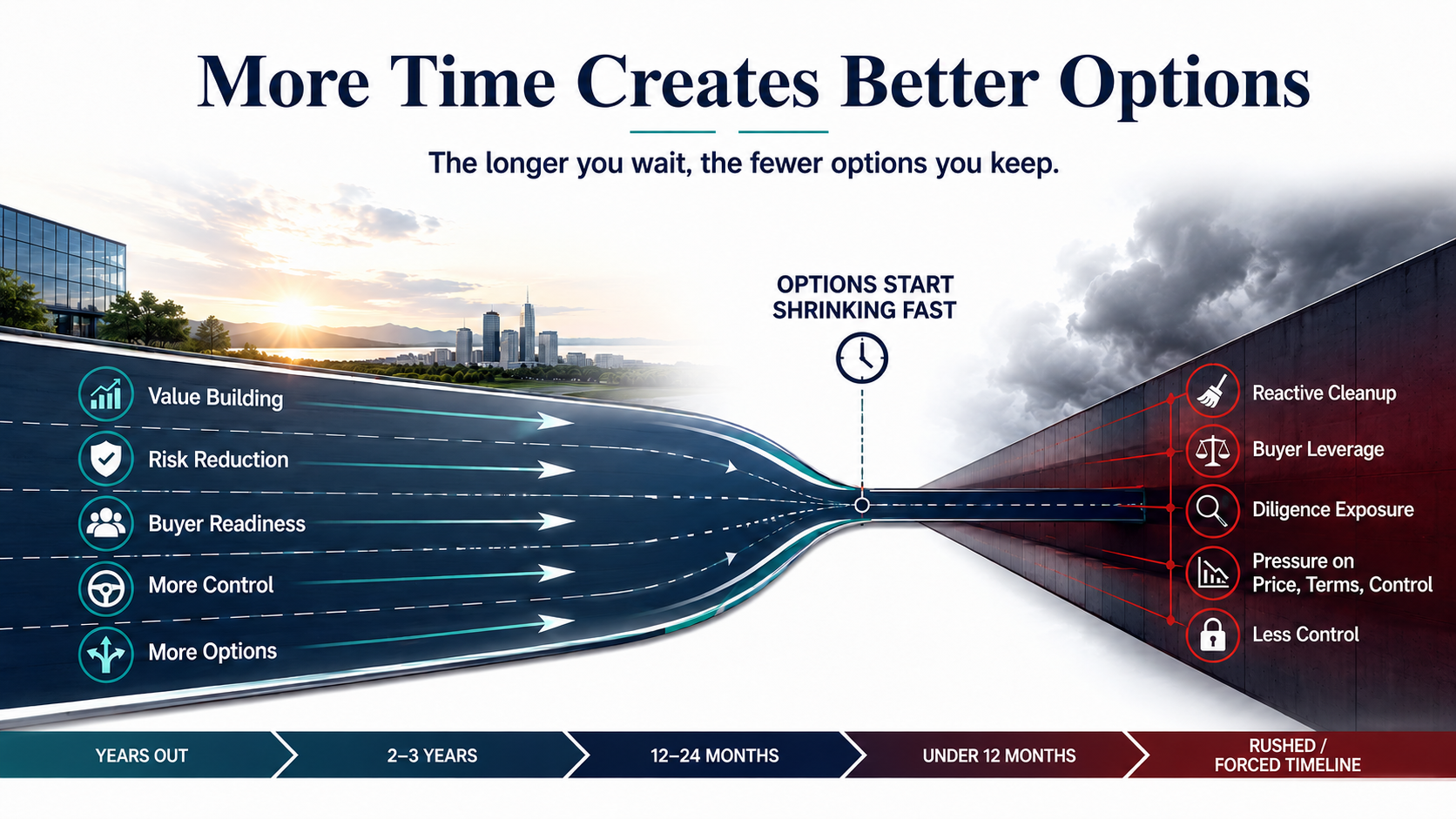
The market can form an opinion in days. You may need months or years to make the opposite story true.
BUILT FROM THE OTHER SIDE OF THE TABLE
This was not built from a seller’s wish list.
It was built from the buyer’s veto.
Exit Mastery was shaped by direct buyer-side experience evaluating e-commerce and service-based businesses. That meant questioning owners, speaking with brokers and bankers, reviewing the numbers and structure, making offers, and walking away when the economics, evidence, or transfer did not hold up.
- Owners questioned directly
- Brokers & bankers involved
- Opportunities reviewed. Offers made.
- Deals walked away from when they did not hold up
That perspective is reinforced by day-to-day operating experience running an IT/MSP and a growth agency. So the system was built for real owner-led companies, where records get messy, clients need special handling, and too much value still lives inside the owner.
Invisible competence stops looking like value when it cannot transfer.
That lesson shaped the questions, sequence, review standards, and decision points inside Exit Mastery.
The lesson was brutal: a good business story can collapse the moment the numbers, structure, and handoff are forced to defend it.
Where Exit Mastery Fits
The broker is not the problem.
Timing is.
A broker can position the business and take it to market. An accountant, attorney, valuation professional, or transaction advisor can become critical as the process moves toward tax planning, valuation, legal structure, negotiation, diligence, and closing.
Some may also help with parts of preparation.
The mistake is letting one of those conversations become your first serious readiness test.
Before the Transaction
Find the gaps while they are still private.
- Find buyer-facing risks.
- Decide what matters first.
- Build evidence behind the value.
Once the Transaction Begins
The business is evaluated, negotiated, and priced.
Buyers and advisors begin testing the numbers, structure, evidence, and handoff.
Before the Transaction
Find the gaps while they are still private.
- Find buyer-facing risks.
- Decide what matters first.
- Build evidence behind the value.
Once the Transaction Begins
The business is evaluated, negotiated, and priced.
Buyers and advisors begin testing the numbers, structure, evidence, and handoff.
So when the broker, buyer, accountant, or attorney enters the picture, you are not paying them to discover what you could have found while you still had time to fix it.
The first serious opinion formed about your business should not come from the person deciding what to pay for it.
WHAT EXIT MASTERY ACTUALLY DOES
Most owners attack the problem they can see.
The expensive problem is often the one they have normalized.
The books could be cleaner. The team could own more. The client mix could be safer. The margins could be stronger. The processes could be documented. The growth story could be sharper.
But a long list is not a strategy.
It is how owners spend months on useful work while the issue most likely to damage the exit remains untouched.
Exit Mastery gives you an order of attack.
- 01It starts with what the exit must produce for you.
- 02It grounds that target against what the business can support today.
- 03It separates the risks that can change the deal from the improvements that can wait.
- 04At two key points, we step in to help interpret the evidence, decide what matters most, and keep the preparation moving in the right direction.
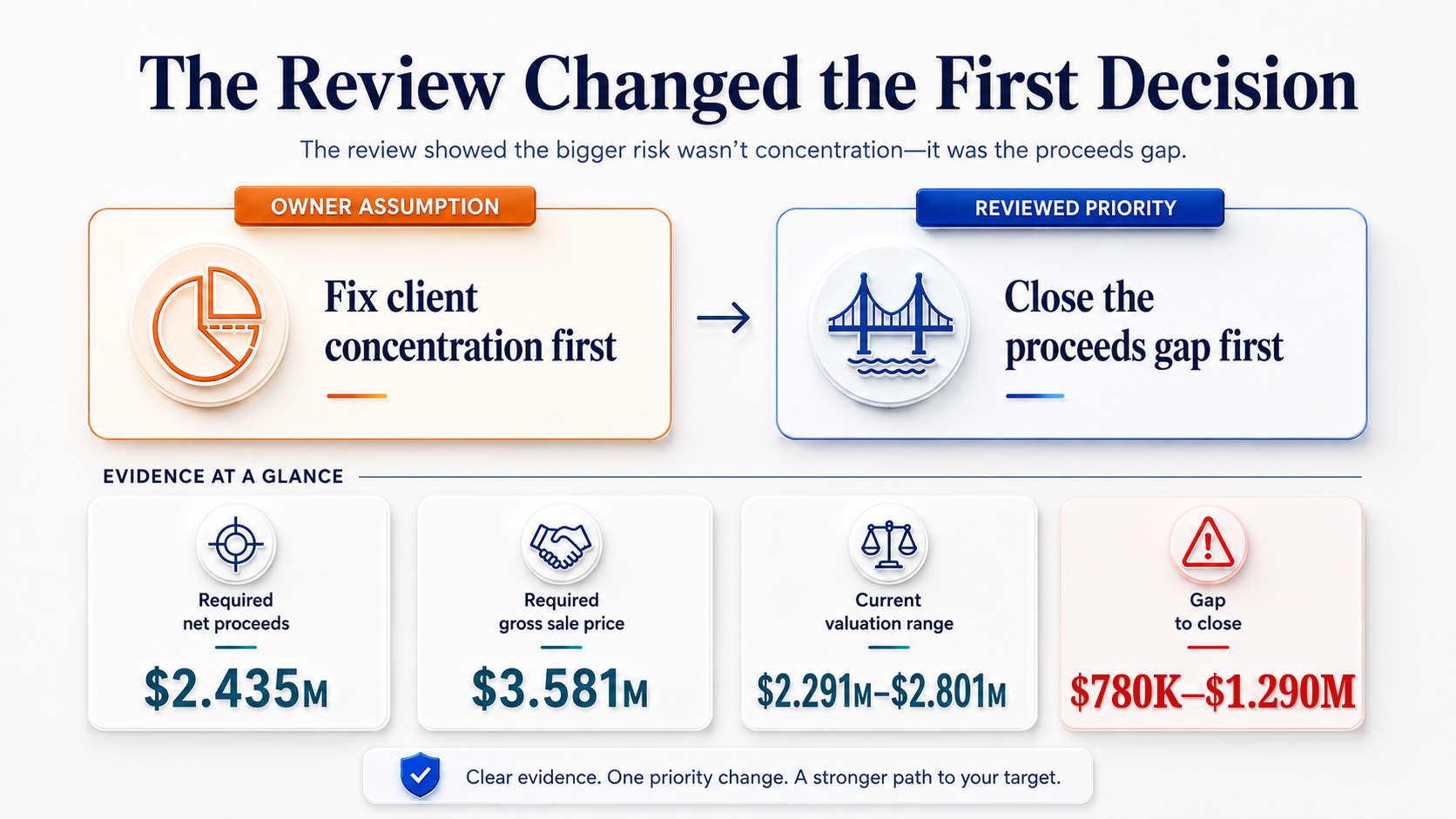
That is the difference between useful work and the right work.
You see what can hurt the next decision, what can wait, and where outside input is needed.
The program is not built to keep you busy. It is built to stop you from spending valuable time on the wrong work.
No sales call. Payment only after acceptance.
THE THREE-STAGE, NINE-STEP ROADMAP
Three stages. Nine steps. One job: make the business harder to discount, harder to derail, and easier to transfer.
The sequence matters because the wrong work in the wrong order still wastes time.
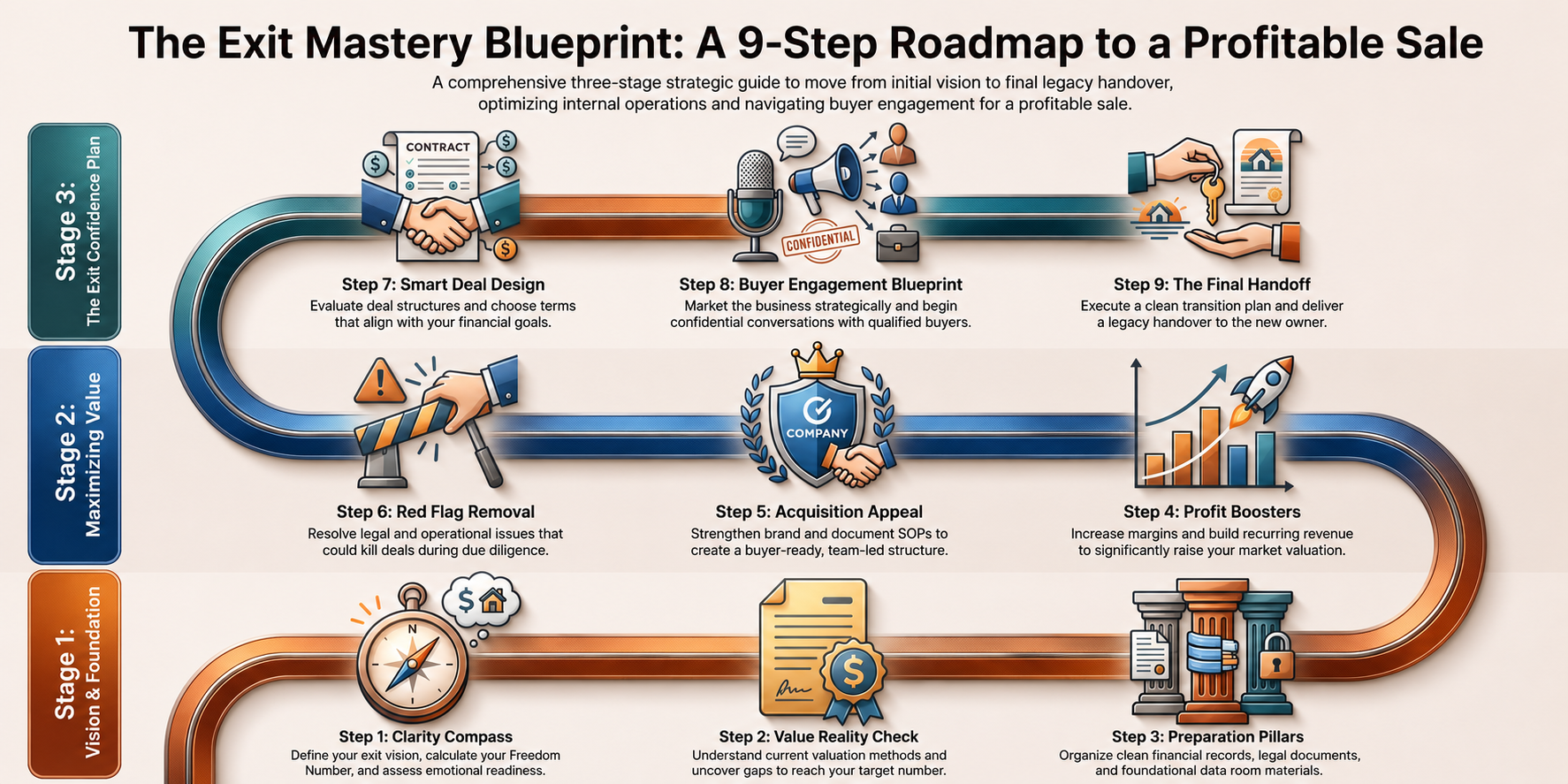
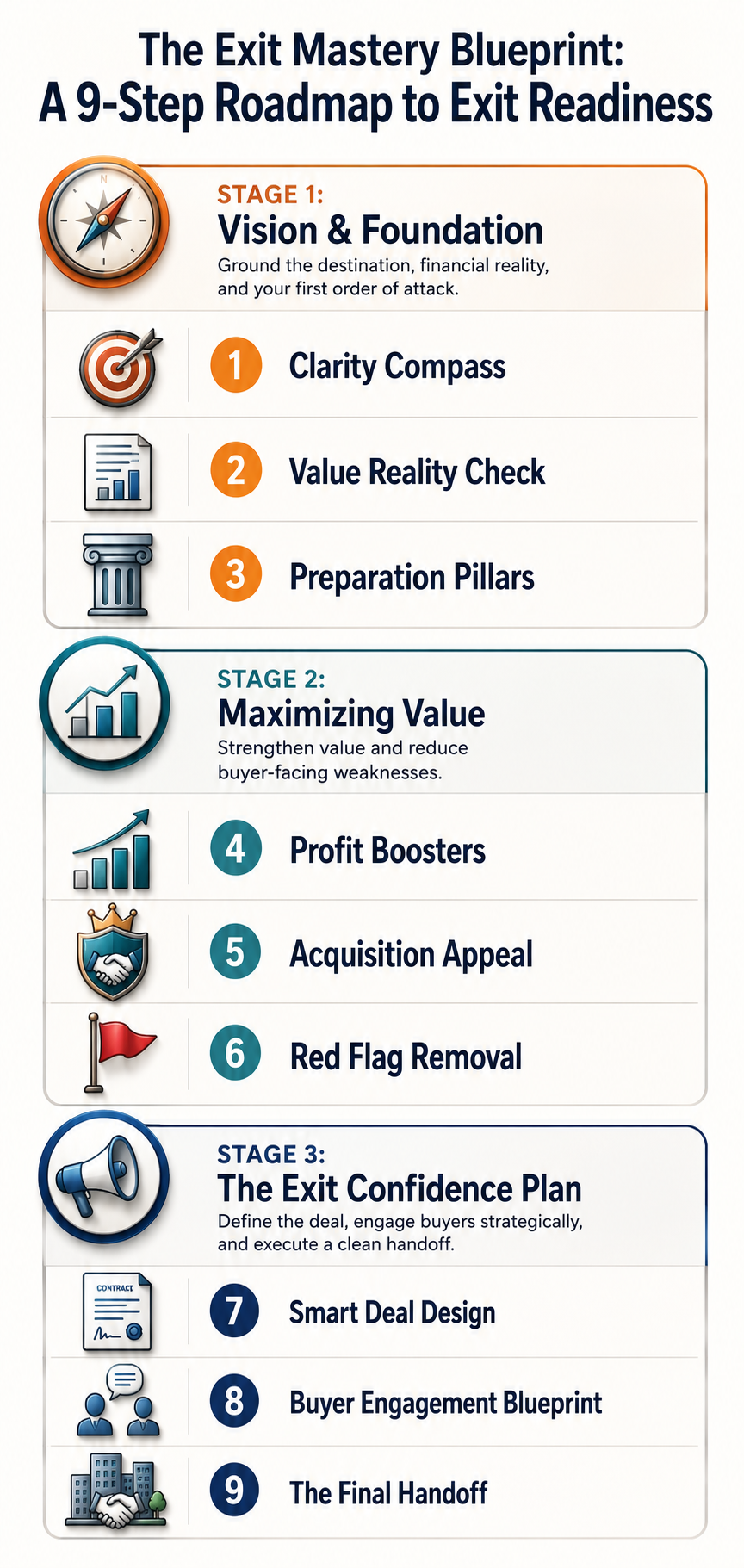
Before buyer outreach begins, we help confirm that the essentials are in place.
The roadmap is not about finishing material. It is about reaching each decision with clearer evidence and more control.
WHAT YOU BUILD
What You Build Before the Questions Get Expensive
A roadmap only matters if it leaves you with something concrete.
By the time you work through Exit Mastery, you are no longer relying on a vague idea of what the business is worth, what needs fixing, or where to begin.
Among the results you build are:
Where you stand financially.
The proceeds target, current value picture, and gap between them.
What is strengthening the exit, and what is still working against it.
Profit opportunities, owner dependencies, red flags, and evidence gaps brought into view.
What you need in hand before buyers start asking questions.
Clearer deal boundaries, stronger supporting evidence, and the materials needed for buyer engagement and handoff.
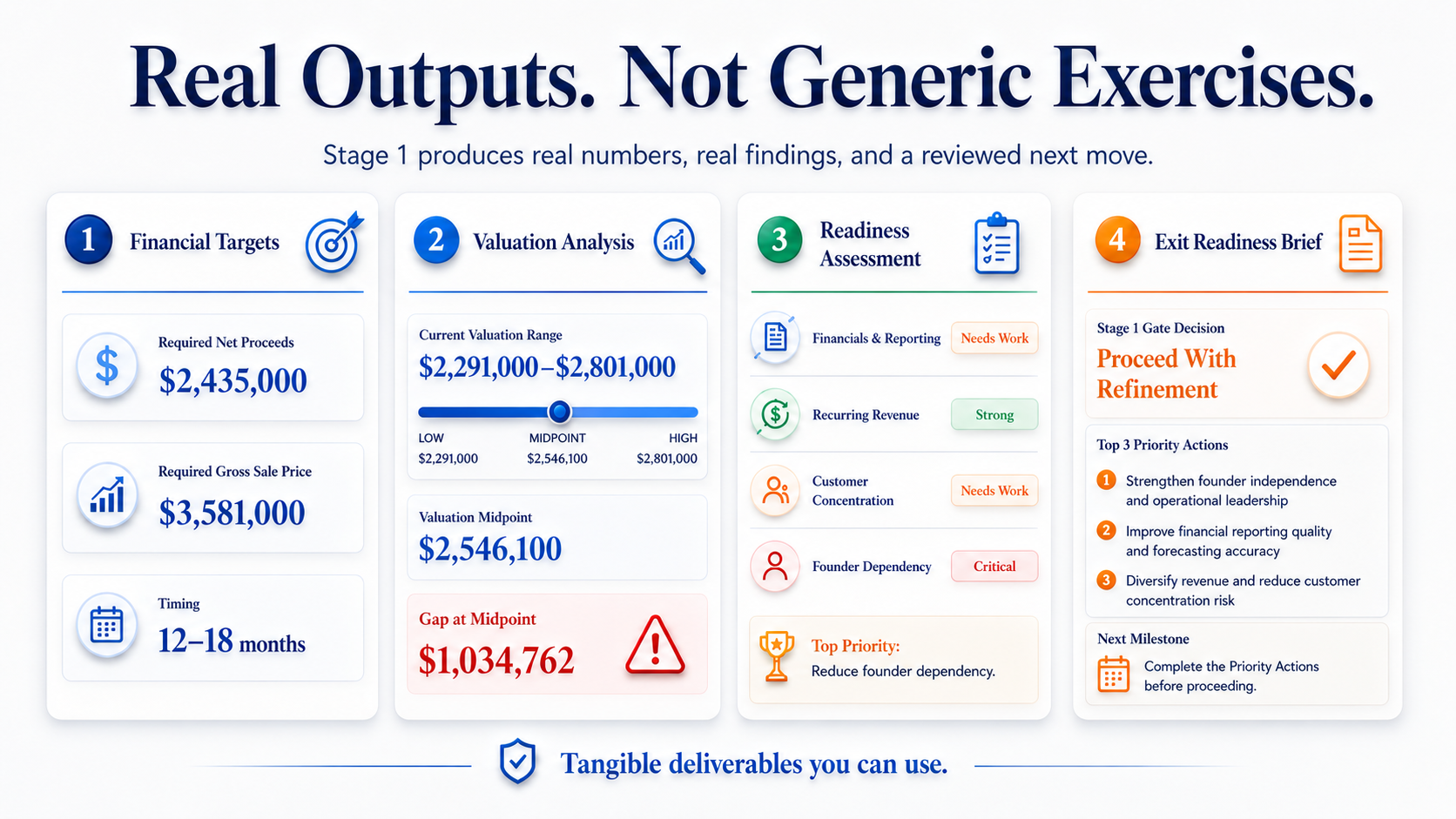
Behind those results are the calculators, diagnostics, trackers, and supporting packs used when the work calls for them.
The point is not to collect files.
It is to stop walking into important conversations with untested assumptions and half-built answers.
READINESS GATES AND WRITTEN DIRECTION
The most dangerous blind spot is the one you can explain away.
You built the business. You know why the exceptions exist, what you intended, and what you believe you could fix if you had to.
That context can make a weak assumption feel reasonable.
The work can look complete to you and still fail under outside scrutiny.
That is why Exit Mastery includes two points where we step in and help you make sense of what the work is showing.
AFTER STAGE 1
We help you ground the financial picture, identify the exposure, and decide what deserves attention first.
AFTER STAGE 2
We help you judge whether the business is moving toward stronger buyer readiness before outreach begins.
Each review produces a written Exit Readiness Brief: a clear summary of what looks strong, what is still exposed, and where to focus next.
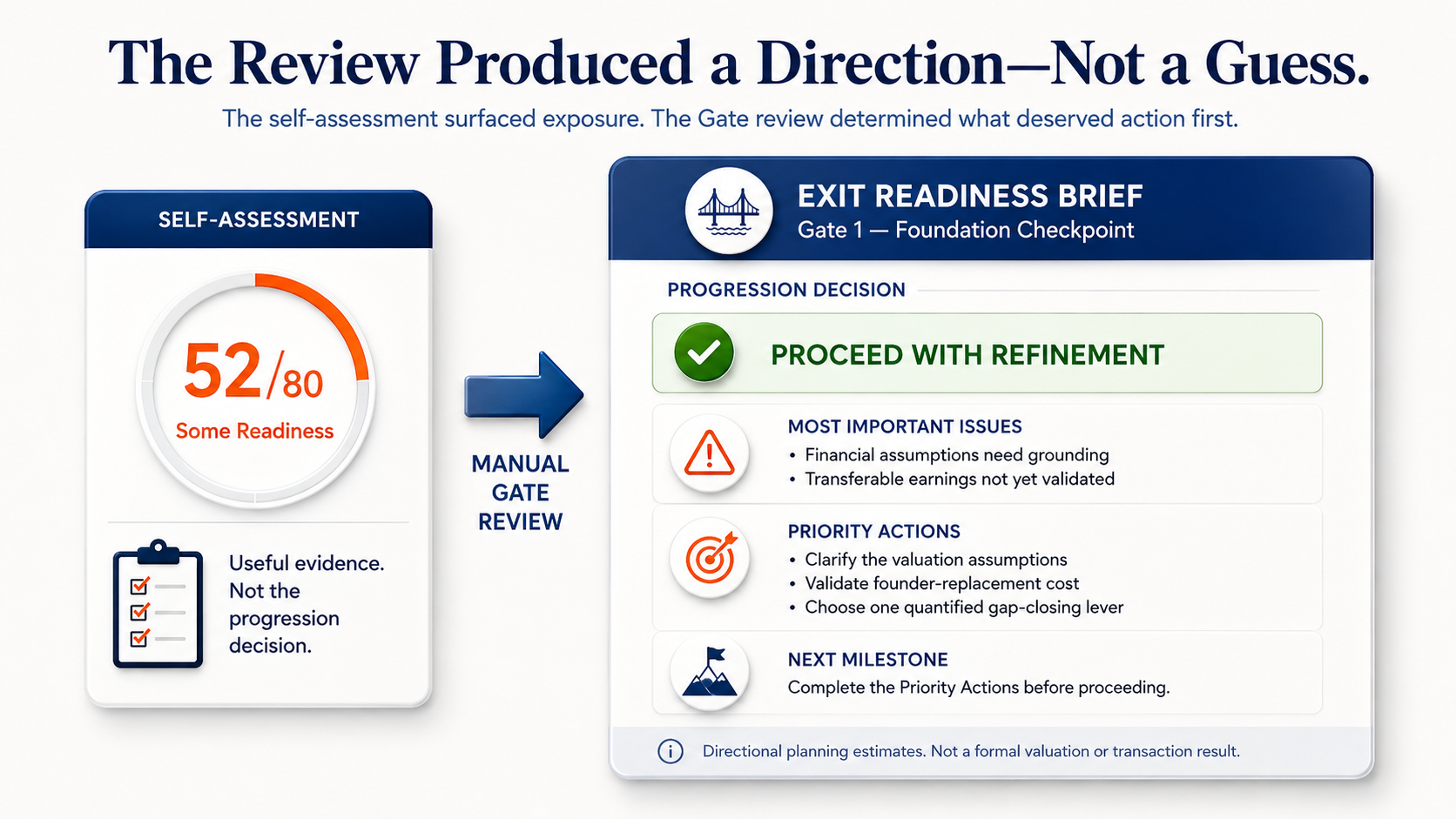
Sometimes the right next move is refinement.
The Clarity Guarantee
Work through Stage 1 and reach the first Readiness Gate. We will step in, review what the work is showing, and help you leave Stage 1 with a clear understanding of where the business is exposed, what deserves attention first, and what your next move should be.
That is the promise: Stage 1 does not end at diagnosis. It ends with a direction you can act on.
The real advantage is a decision shaped by scrutiny, not another assumption dressed up as a plan.
Application required. Payment only after acceptance.
WHO THIS IS FOR AND WHO SHOULD LEAVE
This is for owners who want the truth before they need a buyer to agree.
Exit Mastery is built primarily for profitable owners in two lanes: service-based businesses such as agencies, consultancies, IT/MSP, advisory, and professional services; and digital businesses such as productized services, SaaS/software, and e-commerce.
The strongest fit is usually an owner who has built something meaningful, often in the $750,000 to $10 million revenue range, and knows the next chapter deserves more than a rushed decision.
YOU ARE LIKELY A STRONG FIT IF
- You know you will not run the company forever, even if you do not have a sale date yet.
- You care about the money, terms, transition, and post-close obligations, not just a headline valuation.
- You are willing to confront numbers, dependencies, and risks that may be uncomfortable.
- You will complete the work and involve the right people when their input is needed.
YOU SHOULD LEAVE IF
- You want a reassuring valuation without exposing the assumptions behind it.
- You want somebody to find the buyer, negotiate the transaction, or perform the preparation for you.
- You want a guaranteed price, sale, timeline, or return.
You lead the preparation, but you do not have to manufacture every answer alone.
WHY NOW
Waiting does not preserve your options.
It quietly removes them.
You do not need to sell this year.
You do need to stop assuming you will always get to choose when the work begins.
And if you are already exhausted, that is not proof you should wait.
It may be the clearest evidence that the business has been taking too much from you for too long.
A cleaner financial story
needs consistent records over time.
Reduced owner dependence
needs the team to make decisions, handle relationships, and solve problems without you stepping back in.
Lower customer concentration
needs new revenue, not a sentence in a plan.
A credible growth story
needs evidence that the company can keep producing without heroic effort from the founder.
Those changes do not become believable because you completed them ninety days before listing the business.
They become believable because the business has lived them.
Every year you delay is another year you could have been building the operating history a buyer cannot dismiss as last-minute window dressing.
You tell yourself you have five years.
Then a partner wants out. A health scare changes how much longer you are willing to carry the load. A key employee leaves. A major client does not renew.
None of those events asks whether the business is ready.
Suddenly the five-year plan becomes a twelve-month decision, and the business has not had time to become less dependent on you.
That is how owners lose the luxury of choosing.
The danger is not only that you will be unprepared when you want to sell.
It is that something else may decide when you need to sell.
Preparation started early gives you choices:
- keep the business
- step back
- bring in leadership
- take partial liquidity
- wait for a better market
- pursue a sale from strength
You do not need to sell now. You need to stop assuming you will always get to choose when.
THE INVESTMENT
The Real Cost Is Not What You Spend to Prepare.
It Is What You Give Up by Waiting.
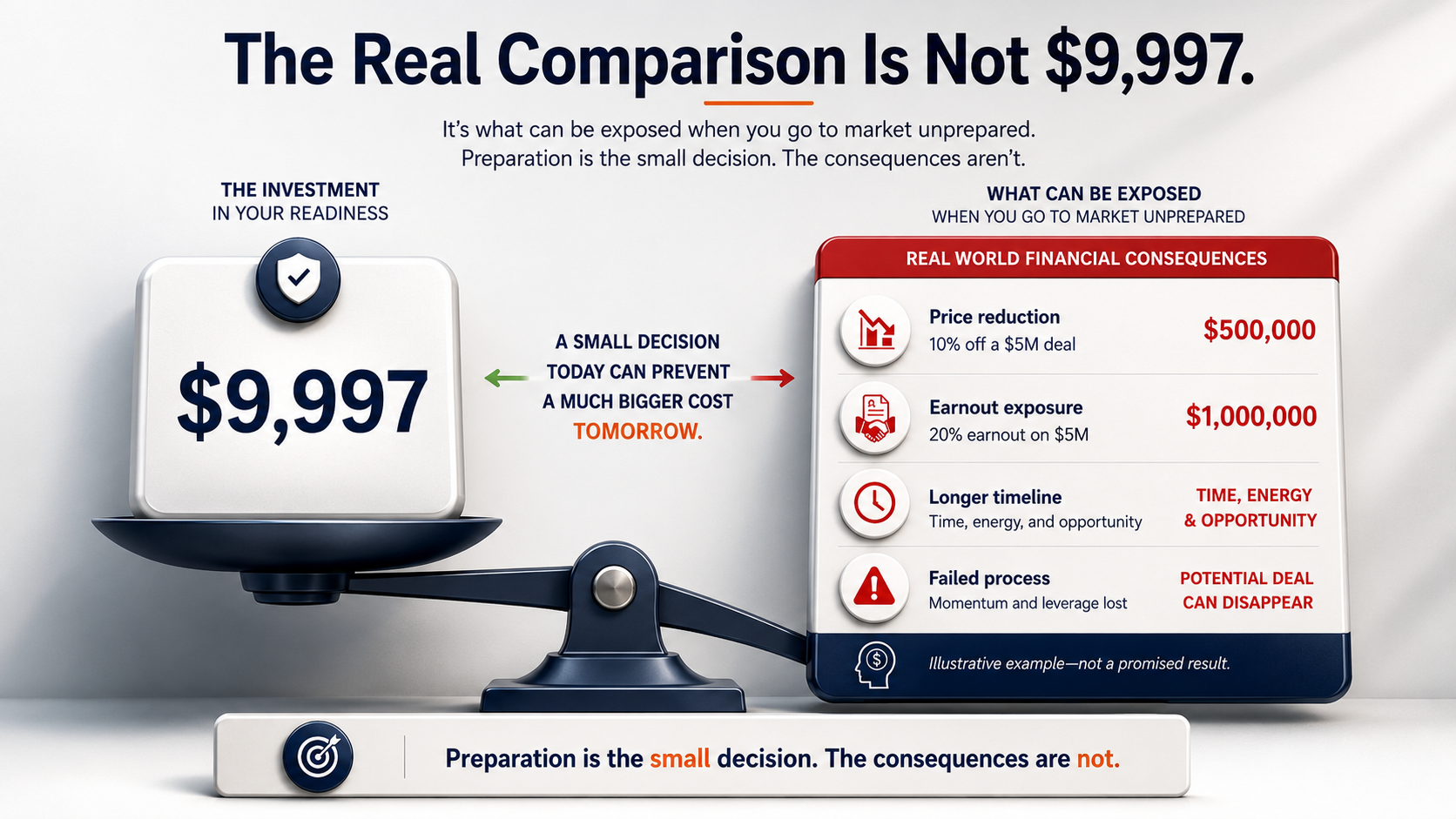
Consider a simple example.
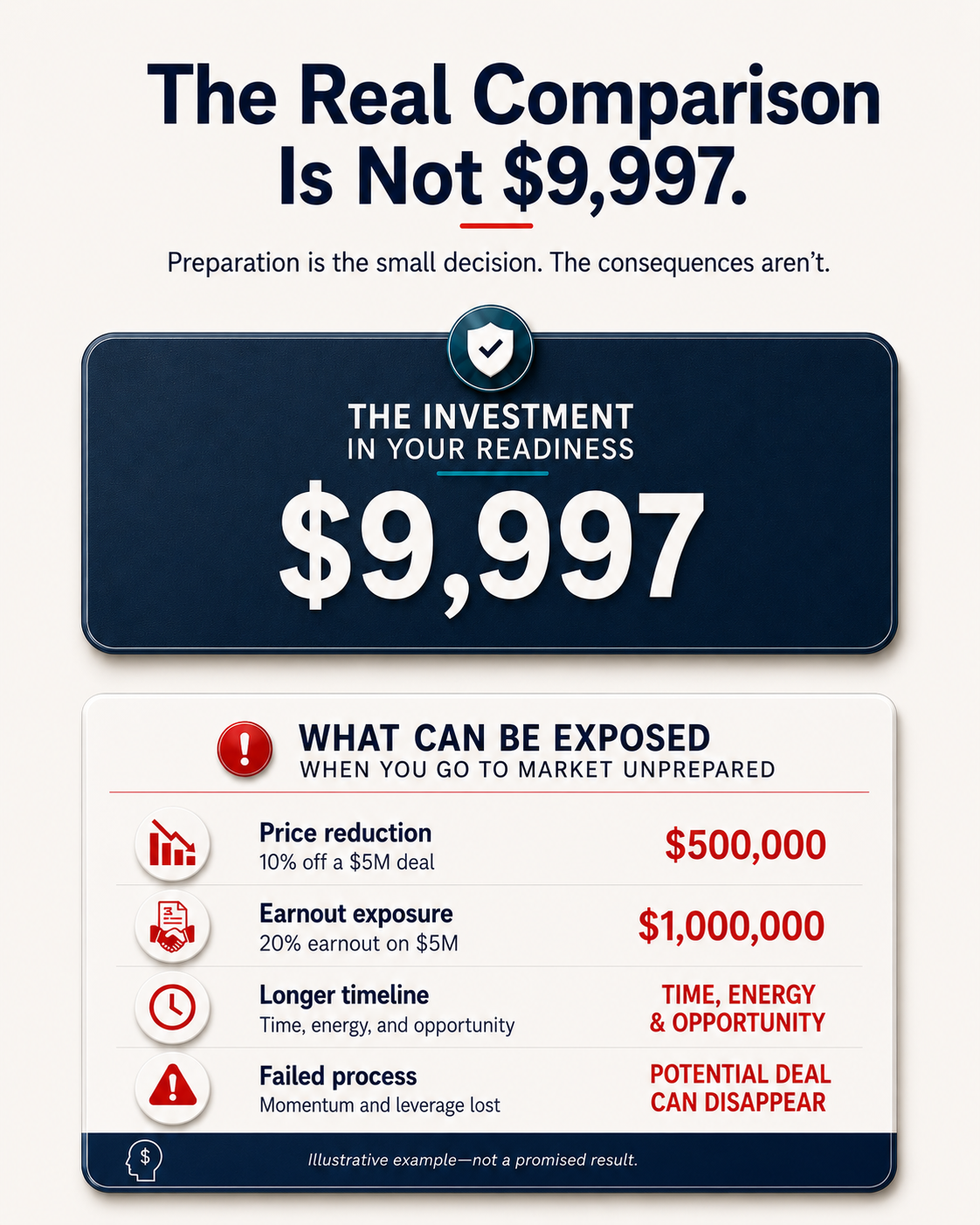
If a business could support a $5 million sale price, a 10% reduction is $500,000 gone.
If a buyer ties 20% of the price to an earnout, $1 million of your proceeds may remain at risk after closing.
And if the business cannot sell at all, the loss is bigger than a discount.
It can mean years of built value never being realized.
A retirement delayed.
A transition you no longer control.
Employees left without the future you hoped to create for them.
Or a legacy that never transfers beyond you.
For an owner who is later in life, burned out, or simply out of runway, a failed sale does not always mean trying again next year.
Sometimes it means turning off the lights, walking away, and watching decades of value disappear without a payday.
That is not just disappointing.
It is tragic.
That is the real comparison.
Not whether preparation is worth the investment.
Whether avoiding the work now could later cost you six figures, seven figures, or the exit itself.
Exit Mastery gives you the complete three-stage system, the tools to do the work, two Readiness Gates, a written Exit Readiness Brief at each Gate, and the Clarity Guarantee.
The value is not the amount of material. It is knowing what can hurt the deal, what deserves attention first, and whether the preparation makes sense before a buyer tests it for you.
Protect what you built. Make the next decision from strength.
Application required. Payment only after acceptance.
WHAT HAPPENS AFTER YOU APPLY
Applying is not a commitment to buy.
It is the fit decision.
The direct application takes approximately 5 to 7 minutes.
There is no phone-number requirement, no sales call, and no financial-document upload.
- 1
Submit the application with information about the business, your current position, and why you are applying now.
- 2
Exit Mastery reviews it personally, usually within 24 to 48 hours, and responds with acceptance, a request for clarification, or a not-a-fit decision.
- 3
If accepted, you receive a secure payment link. You are still free to decide whether to move forward.
- 4
After payment, your access is activated. Begin with Start Here / Orientation, then Stage 1.
FAQ
The questions serious owners ask before they decide.
FINAL DECISION
You Can Discover the Truth in Private.
Or Let the Market Discover It for You.
You spent years building the business.
At some point, it has to do something for you besides demand more from you.
It may need to fund the next chapter, support your family, reward the risk you carried, give your team a future, or simply let you step away without watching the value disappear when you do.
The market will not pay you for the sacrifice.
It will pay for what can survive without you.
OWNERS WHO PREPARE EARLY
Find the truth while it is private, protect the value they built, and keep control of the timeline.
OWNERS WHO WAIT
Let a buyer, diligence team, or changing life circumstance decide when the truth gets exposed and what that uncertainty costs.
You do not need a perfect business. You need to know what is real, what is exposed, and what must change before the market gets a vote.
An owner who wants to protect their family, team, legacy, and future does not wait for someone else to price the risk.
You can keep assuming there will be time later.
Or you can use the time you still control.
Takes approximately 5 to 7 minutes. No sales call. Payment only after acceptance.